French control of Strasbourg
The Life and Opinions of Tristram Shandy, GentlemanFrench control of Strasbourg is the outcome of a political design that the narrative sets against explanations blaming civic pride or financial weakness. In Hafen Slawkenbergius’s account, the city’s fall is also tied to the inhabitants’ mass departure to follow a stranger whose remarkable nose had drawn their attention. The contrasting explanations make the city’s change of control a compact example of how public decisions, political ambition, and collective curiosity can converge.
Political Design and the City’s Vulnerability
The narrative connects the city’s fate to a broader scheme of universal monarchy. A branch of the system, attributed to a plan written by order of Colbert and submitted in manuscript to Louis XIV in 1664, was to secure Strasbourg as a route into Swabia and a means of disturbing the peace of Germany. The city’s eventual capture is therefore presented not as an isolated accident but as the realization of a strategic ambition.
Other commentators in the passage offer rival accounts of why Strasbourg could be taken. One says that its citizens regarded an imperial garrison as an infringement of their freedom and consequently fell to a French one. Another attributes their weakness to financial decisions: they anticipated revenues, incurred taxes, and depleted their resources until they could no longer keep the gates shut. Together, these explanations make the city’s loss appear to arise from a mixture of political judgment and material vulnerability.
Curiosity and the City’s Fall
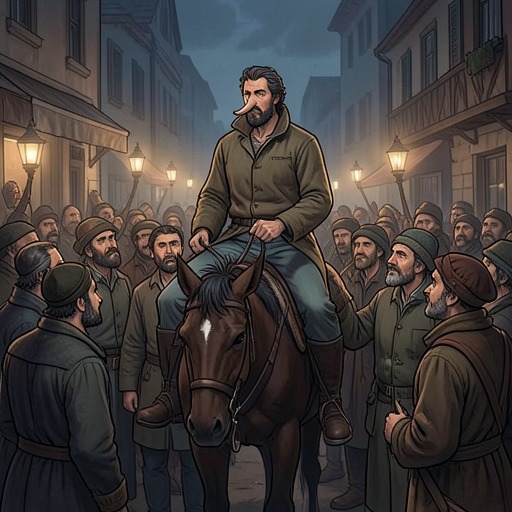
Hafen Slawkenbergius rejects the idea that the French alone forced the city’s gates open. In his account, the decisive opening comes when men, women, and children leave Strasbourg together to follow the stranger’s nose; the French, alert to the opportunity, enter in their wake. The episode turns a political reversal into a scene of collective distraction: the citizens’ attention shifts from the city to a spectacle outside it, and that movement becomes the occasion for French entry.
The account does not erase the strategic plan or the other explanations. Instead, its competing causes resist a single, tidy verdict. Political ambition supplies the larger design, civic opposition and weakened resources supply proposed conditions, and Slawkenbergius’s explanation makes curiosity the immediate opening through which the French take advantage.
Aftermath and Narrative Irony
The passage adds that Strasbourg’s trade and manufactures declined gradually thereafter, but rejects the causes assigned by commercial commentators. Slawkenbergius links the decline to the citizens’ continuing preoccupation with noses, which leaves them unable to attend to their business. The city’s political subjection thus acquires an extended comic aftermath: the same fascination associated with its capture is said to persist as a distraction from civic and commercial life.
By placing strategic history beside an absurdly personal explanation, the narrative makes the city’s fall a study in competing accounts of causation. The loss of control is at once part of a monarchic project and, in Slawkenbergius’s telling, the consequence of a crowd following its curiosity beyond the gates. The comic explanation does not displace the political one; their collision is what gives the episode its force.